

Infrastructure as a Service (IaaS) is a cloud computing model that delivers virtualized computing resources—servers, storage, networking, and operating systems—to enterprises on demand, with customers paying only for resources they consume.
Infrastructure as a Service represents the most fundamental cloud service model, positioned below Platform as a Service (PaaS) and Software as a Service (SaaS) in the cloud stack. For enterprise IT operations, IaaS fundamentally changes how organizations think about compute resources. Rather than purchasing and maintaining physical servers that sit idle during off-peak hours, enterprises can scale infrastructure up and down based on actual demand. This flexibility has become non-negotiable for organizations competing in rapidly changing markets where business requirements shift quarterly or even weekly.
Why IaaS Matters for Enterprise Operations
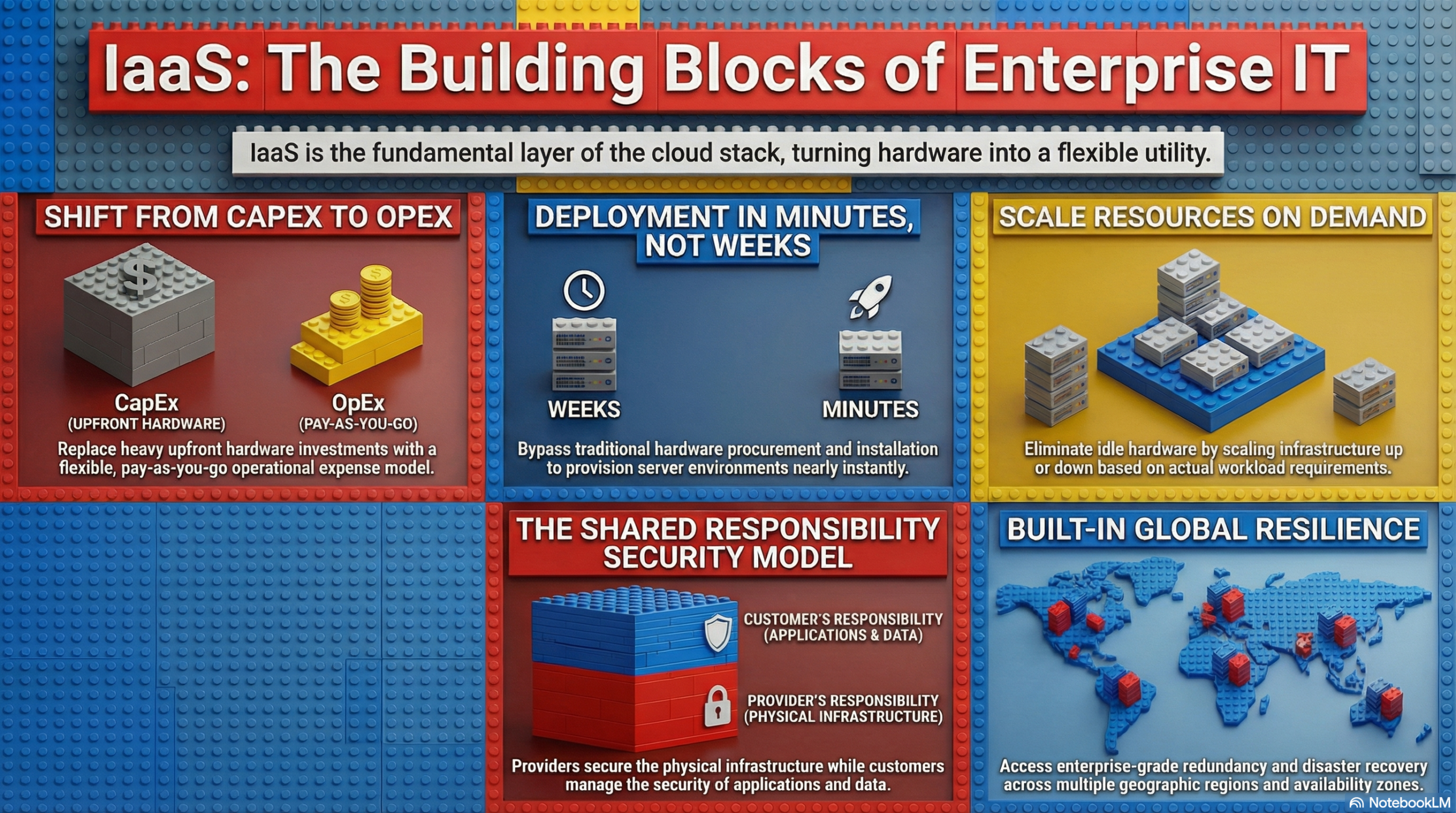
Infrastructure as a Service shifts operational responsibility and financial risk. Instead of capital expenditure for hardware that depreciates and eventually requires replacement, enterprises pay operational expenses only for resources consumed. For IT directors managing budget constraints, this conversion from CapEx to OpEx simplifies financial forecasting and allows reallocation of capital to strategic initiatives rather than hardware procurement and replacement cycles.
The operational agility enabled by IaaS is transformative. Provisioning a new server environment that would take weeks through traditional procurement—ordering equipment, receiving it, unpacking, installing, configuring networking, and deploying applications—now takes minutes through Infrastructure as a Service platforms. This speed compounds across large enterprises running hundreds of applications, multiplying the efficiency gains. Furthermore, IaaS providers operate globally distributed data centers, enabling enterprises to deploy applications closer to users and customers without building physical infrastructure in every region they serve.
Resilience and disaster recovery capabilities embedded in Infrastructure as a Service platforms exceed what most enterprises can economically build themselves. IaaS providers offer redundancy across availability zones and regions, automated backups, and failover mechanisms that protect applications against hardware failures, data center outages, and regional disasters. For enterprises with regulatory obligations to maintain business continuity, this built-in resilience is invaluable.
How IaaS Functions in Enterprise Environments
Infrastructure as a Service operates through a hypervisor layer that virtualizes physical servers, allowing multiple virtual machines to run on single physical hardware. Each virtual machine receives isolated computing resources—CPU, RAM, disk storage—that appear dedicated even though they’re actually shared. Cloud providers manage the underlying physical infrastructure, handling hardware failures, security patches, and capacity planning transparently to customers.
Customers interact with Infrastructure as a Service through web-based consoles or APIs, selecting machine types appropriate for their workloads. A customer might provision a high-memory instance for data analytics, a standard compute instance for web servers, or a GPU-accelerated instance for machine learning training. This granular resource selection is a defining characteristic of Infrastructure as a Service—applications can be matched precisely to workload requirements, avoiding the inefficiency of standardized hardware.
Storage in Infrastructure as a Service comes in multiple forms. Block storage provides virtual disks that attach to compute instances, enabling database deployments and other stateful applications. Object storage allows scalable data storage with API access, ideal for logs, backups, and unstructured data. Managed databases abstract the operational complexity of database administration while maintaining the performance and reliability enterprises require. Networking components—virtual private clouds, load balancers, firewalls, and VPN connections—allow customers to architect secure, scalable network topologies.
Key Considerations for IaaS Adoption
Vendor lock-in represents a significant consideration for enterprises evaluating Infrastructure as a Service. Each major IaaS provider uses proprietary tools, services, and APIs that make migrating applications to competing platforms difficult and expensive. Large enterprises often mitigate this risk through multi-cloud strategies, deliberately distributing workloads across multiple Infrastructure as a Service providers to maintain negotiating leverage and reduce dependency on any single vendor.
Cost optimization in IaaS requires active management. The ease of provisioning infrastructure can lead to cost sprawl if teams deploy resources without discipline or decommission unused environments slowly. Implementing cloud cost management practices—reserved instances for predictable workloads, spot instances for fault-tolerant batch jobs, right-sizing instances after monitoring actual usage patterns—becomes essential for maintaining financial control. Many enterprises employ dedicated cloud financial operations teams to optimize IaaS spending continuously.
Security responsibility in Infrastructure as a Service follows a shared model. While IaaS providers secure the underlying physical infrastructure and virtualization layers, customers must configure security groups, manage encryption keys, control identity and access, and monitor for threats. This shared responsibility requires enterprises to understand exactly where provider responsibility ends and customer responsibility begins. Misaligned security expectations are a common source of security incidents in IaaS environments.
IaaS in Broader Cloud Architecture
Infrastructure as a Service forms the foundation for organizations pursuing cloud-native development practices. Containerized applications running on Kubernetes can be deployed to IaaS compute instances, enabling organizations to build microservices architectures that scale elastically based on demand. The combination of IaaS infrastructure and container orchestration creates powerful platforms for modern application development.
For enterprises undertaking cloud migration from on-premises data centers, IaaS is often the natural starting point. Virtual machines running in IaaS can replicate on-premises architectures, allowing teams to lift-and-shift applications without requiring immediate architectural transformation. This approach provides quick wins—moving from capital expenditure to operational expenditure while still maintaining operational familiarity with virtual machine management.