












 USE CASE - AI
Enterprise AI for Core and Edge
Scality ADI is the autonomous data infrastructure for enterprise AI. One platform across the full AI lifecycle of memory, learning, and thinking, and across the topology AI actually runs in: core and edge, with bi-directional flow between them. The data plane production AI requires.



 THE PRESSURES
Pressures the enterprise AI program is operating under.

workloads
AI is now four workloads, not one.
Training pulls on sustained throughput. Inference pulls on low latency. Retrieval pulls on IOPS and metadata performance. Agents pull on all three at once. The data infrastructure has to serve every shape on the same platform.
CORE TO EDGE
AI is moving out of the data center.
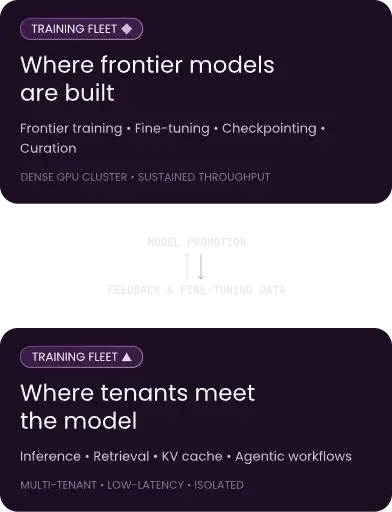
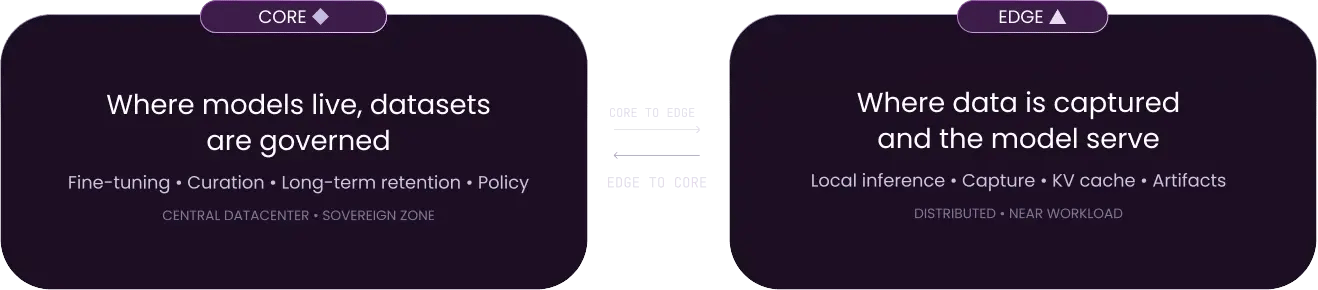
NeoClouds host model providers, AI builders, and end customers on the same infrastructure. Isolation, quotas, and perManufacturing lines, hospitals, branches, and field sites now run inference where the work happens. The platform has to serve a centralized training fleet and distributed inference sites under one namespace, with model promotion and feedback flowing back to the core.
DATA GRAVITY
AI fails when the data is scattered
Enterprise data sits across applications, archives, file shares, and object stores. Copying it into a separate AI tier creates governance gaps, doubles the cost, and stalls the pipeline. The platform has to make the data usable in place.
Resilience
AI doesn't change the regulator's posture.
The board, the regulator, and the cyber-insurance carrier still expect immutability, recovery, and audit trail. AI workloads inherit that posture rather than escape it. The platform has to carry it without slowing the GPU.
 THE SCALITY ANSWER
An architectural response to each pressure


Workload-aligned media.
Hot, warm, and cold data on the right tier under one namespace and one lifecycle.
AI-scale object access.
MultiScale grows capacity, throughput, and operations independently. High-concurrency S3 and S3 over RDMA keep GPUs fed.
CORE5 cyber resilience.
Defends AI data the same way the rest of the data plane is defended.
Real-time power awareness.
Performance decisions bound to facility limits, not theoretical assumptions.

AI WORKLOADS WE SERVE
A selection of the AI workloads running on Scality ADI today.
What the model is built on.
What the model is built on.
What the model is built on.

The corpora, knowledge bases, and indexes the AI reaches into. The slowest data to rebuild. The most expensive to lose.
Workloads in this group: multimodal corpora, retrieval-augmented knowledge bases, vector indexes, indexed enterprise data. Durable, indexed, governed, retrievable at the speed of the workload pulling against it. The storage tier underneath absorbs three different access patterns from the same shared substrate.

Challenges.
Vector indexes that don't fit in any sensible cache. RAG corpora growing faster than the budget projected last quarter. Multimodal data with mixed access patterns. Sovereignty and residency rules that apply to AI data the same way they apply to financial records.

Benefits of Scality ADI.
Workload-aligned media places hot, warm, and cold data on the right tier under one namespace and one lifecycle policy. Object metadata is searchable and indexable for retrieval workflows. GPU-Direct paths are available where the workload needs them.
Where the GPUs do the work.
Where the GPUs do the work.
Where the GPUs do the work.
Training, fine-tuning, checkpointing. The phase where the storage layer either keeps up or wastes the GPU budget.
Workloads in this group: training, fine-tuning, checkpointing. The phase where the storage tier is most visible to the AI team and most expensive when it fails. GPUs starve when reads can't keep up. Training runs stall when checkpoints can't land durably and quickly.
Challenges.
Training corpora that don't fit on a single performance tier. Checkpoints that need to be durable the moment they land. Fine-tuning passes that have to read the same dataset repeatedly without recopying it. The temptation to put everything on flash and the bill that follows.
Benefits of Scality ADI.
High-concurrency S3 access and GPU-Direct data paths keep GPUs fed at scale. Durable, immutable checkpointing built into the same platform that holds the corpus. Performance at scale, not benchmark peak.
Production AI, under SLA.
Production AI, under SLA.
Production AI, under SLA.
Inference, retrieval, KV cache, agentic workflows. The phase where storage latency becomes user latency.
Workloads in this group: inference, retrieval, KV cache, agentic workflows. Where AI meets the customer. The storage tier underneath has to deliver low-latency object access at production concurrency, and the artifacts the agents produce have to land somewhere durable and auditable.
Challenges.
RAG retrieval that has to finish inside the user-visible budget. KV cache that needs to be shared across distributed inference nodes without each node holding its own copy. Agent workflows that write artifacts at machine speed and want them recoverable. Production SLAs that don't bend to storage realities.
Benefits of Scality ADI.
Low-latency object access for serving paths. Centralized cache for distributed inference. Durable, governed storage for the artifacts AI agents produce, on the same substrate that holds memory and learning. One namespace across the lifecycle.
THE WORKFLOW UNDER ONE PLATFORM
Memory, learning, and thinking, across core and edge, on one substrate.
The AI data lifecycle and the AI topology in one picture. The three lifecycle phases above. Core and edge surfaces below. Scality ADI as the substrate that carries both.

Runs on the training fleet. Sustained throughput to feed GPUs, durable checkpoints at fleet scale.

Runs on the training fleet. Sustained throughput to feed GPUs, durable checkpoints at fleet scale.

Runs on the training fleet. Sustained throughput to feed GPUs, durable checkpoints at fleet scale.
 SCALITY ADI
the scality advantage
Scality technologies that show up most under AI cloud workloads.
AIconnect
The data plane connects to the AI stack.
AIconnect brings Scality ADI into the toolchains NeoCloud tenants already run: training frameworks, vector databases, retrieval pipelines, MLOps. Standard interfaces, NVIDIA-validated GPU-Direct paths, no toolchain rewrite.

Guardian
Operations that scale without scaling the team.
Guardian surfaces insights, recommends actions, and executes within operator-defined policy bounds. NeoCloud teams stay lean as the tenant base grows, with the audit trail attached.

MultiScale
Capacity, throughput, and operations on independent axes.
MultiScale grows each dimension on its own axis. The cluster adds throughput without forcing a capacity refresh, and capacity grows without forcing a performance rebuild. Hardware-flexible, generation-spanning.

VALIDATED AI CLOUD ECOSYSTEM
Integrated with the AI stack NeoCloud tenants already run.
Scality ADI sits underneath the frameworks, GPU-direct paths, vector databases, and orchestration tools running frontier- model and large-scale inference workloads. Tenants don't rebuild the toolchain to put their data on the operator's platform.
 FEATURED PARTNERSHIP
Groupama G2S manages backup and storage for one of France's largest mutual insurance groups. Scality ADI with Guardian autonomous operations carries the day-to-day, freeing the team to focus on the security and control standards that regulated insurance work requires.



Bring the cluster spec. We'll show you the storage.