














 Scality Ecosystem & Application Partners
Scality and NVIDIA.
Scality powers the data preparation and model training stages of the NVIDIA AI Data Platform. ADI for enterprise AI and neocloud use cases, ARTESCA for AI at the edge.


the problem
AI training stalls when storage cannot keep GPUs saturated.
Local NVMe does not hold the dataset. Cold data still has to be reachable for the next experiment. IO wait is wasted training cycles, and wasted training cycles are wasted GPU hours.
- GPU IO wait turns into wasted training cycles.
- Dataset is bigger than local NVMe can hold.
- Cold experiments still need to be reachable.
- One corpus has to feed training, fine-tuning and inference.
 the joint solution
Scality powers the data prep and model training stages of the NVIDIA AI Data Platform.
ADI is the primary AI data layer for enterprise AI and neocloud deployments. ARTESCA covers AI footprints at the edge. RING sits underneath for exabyte capacity. GPUs stay saturated whatever the deployment shape.
- ADI for enterprise AI and neocloud use cases.
- ARTESCA for AI at the edge.
- RING underneath for exabyte capacity.
- S3 and S3-over-RDMA paths keep GPUs saturated.
joint solution benefits
What the joint AI stack unlocks.

GPU idle time drops to zero.
ADI delivers data faster than the cluster can consume it. The bottleneck stops being the path between storage and GPU.

One data layer across the pipeline.
Ingestion, preparation, training, inference and archive on one Scality cluster. No staged copies between phases.

Metadata at billion-object scale.
Tag, query and serve subsets of training data without moving anything. Object storage handles what NAS chokes on.

Open by architecture.
Standard S3 API. NIM- and Kubernetes-ready. Workloads move between on-prem and cloud without refactoring.
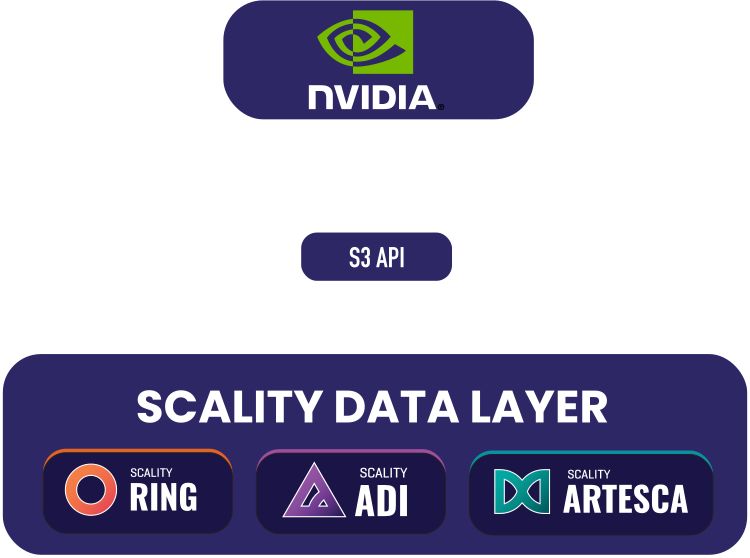
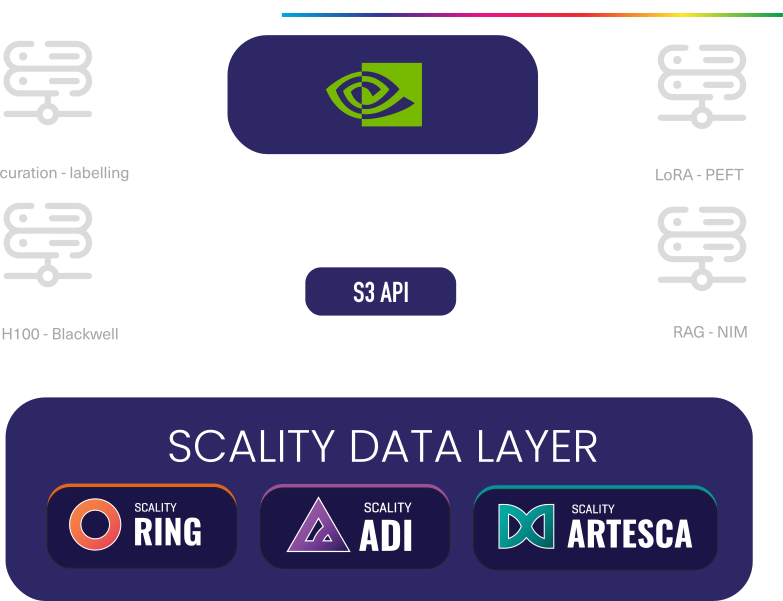
Joint architecture
How NVIDIA runs on Scality.
Workloads flow through the partner integration and land on the Scality data layer.
Giorgio Regni and Paul Speciale on the NVIDIA AI Data Platform.
Scality CTO and CMO walk through how Scality powers the two most critical stages of the NVIDIA AI Data Platform — data preparation and model training. Working-architect view, no marketing.

Show us the workflow. We will show you the fit.