












 USE CASE - BACKUP
Immutable Backup and Recovery
Scality ARTESCA is the immutable backup target for mid-market IT. Ransomware-ready by default, S3-native to the backup stack already in production, and quiet enough to run in the background until the day recovery has to work.



 THE PRESSURES
Pressures the backup program is operating under.

THREAT
The backup is now the target.
Ransomware operators go after the backup repository first. Compromised admin credentials and hostile backup processes mean the recovery path is part of the attack model, not the escape hatch.
Complexity
Backup shouldn't need a specialist.
Mid-market IT doesn't carry a dedicated storage engineer. Multi-quarter integration projects aren't in scope. The target has to deploy in a day, run quiet, and recover without a runbook rewrite.
BUDGET
The target has to land inside what's already approved.
Mid-market IT runs on flat or modest growth. The backup refresh competes with everything else. Total cost over the cycle matters more than the line item on the PO.
TEAM
The team is already running flat out.
Backup admins also run patch cycles, helpdesk escalations, and the next migration. The target has to deploy in days, run quietly, and recover without a runbook rewrite.
 THE SCALITY ANSWER
How the platform proves recoverability


Immutability.
Object Lock enforced at the storage layer. The retention policy holds under compromised admin credentials and hostile backup processes.
Recoverability.
Distributed erasure coding and self-healing under failure events. Recovery runs from the same platform that held the data, in the format the backup app already speaks.
Affordability.
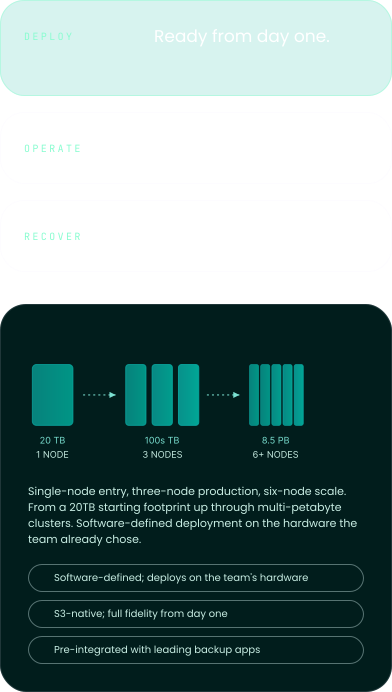
Software-defined deployment on standard hardware. Starts at a 20TB single node, scales into multi-petabyte clusters without re-platforming the backup target.
Operability.
S3-native to the backup stack already in production. Non-disruptive upgrades, quiet telemetry, no daily babysitting.

deploy
What ARTESCA does in the working week, across the life of the target.
Three phases that span the life of a backup target. Each phase is what the team experiences, not what the marketing slide claims.


the scality advantage
Scality technologies that show up most under backup workloads.

CORE5
Five layers, working as one.
API. Data. Storage. Geographic. Architecture. Cyber resilience built across five independent layers so a stolen credential, a privilege escalation, or a physical breach is never enough to lose data.


MultiScale
Capacity, throughput, and operations on independent axes.
MultiScale grows each dimension on its own axis. The cluster adds throughput without forcing a capacity refresh, and capacity grows without forcing a performance rebuild. Hardware-flexible, generation-spanning.

VALIDATED BACKUP ECOSYSTEM
Integrated with the backup stack the enterprise already runs.
Scality ARTESCA sits underneath the backup applications already in production. The recovery path doesn't require rebuilding the toolchain or changing the operator runbook.
 FEATURED PARTNERSHIP
“Our customers can now decide to keep their backups immutable for whatever length of time suits them. Once a backup is made and the policy is set, the data cannot be modified.”



See how immutable storage fits into your backup environment.