












 USE CASE - AI cloud
AI Cloud for NeoClouds
NeoClouds and frontier model providers operate GPU-dense infrastructure that has to serve many tenants, feed sustained training and inference workloads, and stay inside a power envelope the facility can deliver. Scality ADI is the storage built for that operating envelope. GPU-direct access, multi-tenant isolation, and predictable performance from the first cluster through fleet scale.



 WHY WE EXIST
Pressures the AI buyer is already feeling.

gpus
GPUs starve when storage falls behind.
Training runs stall on slow checkpoints. Inference latency drops the SLA when retrieval blocks. The storage layer has to feed GPU- direct paths at sustained line rate, not benchmark peaks.
tenancy
Many tenants, one platform, no leaks.
NeoClouds host model providers, AI builders, and end customers on the same infrastructure. Isolation, quotas, and per-tenant governance have to live in the architecture, not in a control plane the operator has to maintain.
power
Power is the binding constraint.
Capacity is bounded by what the facility can power and cool. All- flash for every terabyte doesn't fit the envelope. The storage tier has to absorb hot, warm, and cold AI data on the right media without breaking the budget.
economics
Predictable economics over the GPU cycle.
Operators commit to GPU fleets ahead of revenue. The storage layer has to scale without forklifts, run on hardware-flexible deployment, and hold the cost curve flat as the cluster grows.
operations
Storage grows faster than headcount.
NeoCloud teams are lean. More tenants, more workloads, more policies, no more people. The platform has to operate itself within policy, with the audit trail attached.
 THE SCALITY ANSWER
An architectural response to each pressure


GPU-direct access.
High-throughput S3 and extreme-throughput S3 over RDMA, integrated with NVIDIA Dynamo, at Neocloud scale. GPUs stay fed, training runs hold their schedule, inference holds its SLA.
Multi-tenant isolation.
Tenant boundaries enforced in the architecture, with per-tenant quotas, governance, and policy. Model providers, AI builders, and end customers share infrastructure without sharing state.
Power-aware media tiering.
Hot, warm, and cold AI data on the right media under one namespace and one lifecycle. Capacity sized to the facility envelope, not to an all-flash dream.
Predictable economics at fleet scale.
MultiScale grows capacity, throughput, namespace, and operations on independent axes. Hardware-flexible deployment, no forklift refresh, cost curve flat as the cluster grows.

AI WORKLOADS WE SERVE
The workloads NeoClouds and frontier-model providers run on Scality ADI.
What the cluster is built on.
What the cluster is built on.
What the cluster is built on.

The corpora, model weights, and indexes that tenants and frontier-model providers store on the platform. The slowest data to rebuild. The most expensive to lose.
Workloads in this group: frontier-model training corpora, multimodal datasets, model weights, retrieval-augmented knowledge bases, vector indexes. Many tenants storing many corpora on the same platform. The storage tier absorbs concurrent reads and writes across tenants without one starving another.

Challenges.
Petabyte-class training corpora that several tenants pull against in parallel. Model weights and checkpoints that have to land durably the moment they're written. Vector indexes that don't fit on any single tier. Power and cost envelopes that don't allow all-flash for every terabyte.

Benefits of Scality ADI.
Power-aware media tiering places hot, warm, and cold data on the right tier under one namespace and one lifecycle. Object metadata is searchable for tenant retrieval workflows. Per-tenant quotas and isolation enforced in the architecture. GPU-Direct paths available where the workload needs them.
Where the GPUs earn the bill.
Where the GPUs earn the bill.
Where the GPUs earn the bill.
Frontier training, large-scale fine-tuning, checkpointing. The phase where storage either keeps up with the GPU fleet or wastes the capex.
Workloads in this group: frontier-model training, large-scale fine-tuning, checkpointing across thousands of GPUs. The phase the operator is most visibly accountable for. Idle GPUs are revenue left on the floor, and the storage tier is usually the bottleneck.
Challenges.
Training corpora that don't fit on a single performance tier. Checkpoints that have to land durably across thousands of GPUs simultaneously. Fine-tuning passes from many tenants reading the same dataset in parallel. Sustained throughput at fleet scale, not benchmark peaks.
Benefits of Scality ADI.
High-concurrency S3 with NVIDIA-validated GPU-Direct paths keeps GPUs fed at fleet scale. Durable, immutable checkpointing built into the same platform that holds the corpus. Sustained throughput, not benchmark peak. Per-tenant quotas so one customer's run doesn't starve another's.
Inference at multi-tenant scale.
Inference at multi-tenant scale.
Inference at multi-tenant scale.
Inference, retrieval, KV cache, agentic workflows for many tenants. The phase where storage latency becomes the tenant's SLA.
Workloads in this group: inference at scale, retrieval, KV cache, agentic workflows for many tenants concurrently. The phase where the operator's SLA is on the line every second. Storage latency, tenant isolation, and durable artifact capture all matter simultaneously.
Challenges.
RAG retrieval that has to finish inside the user-visible budget for every tenant. KV cache shared across distributed inference nodes without each node holding its own copy. Agent workflows writing artifacts at machine speed, durably, with per-tenant boundaries. Production SLAs that don't bend to storage realities.
Benefits of Scality ADI.
Low-latency object access for serving paths under multi-tenant load. Centralized cache for distributed inference, shared cleanly across tenants. Durable, governed storage for the artifacts AI agents produce, on the same platform that holds training corpora and weights. One namespace across the lifecycle, per-tenant boundaries enforced in the architecture.
THE AI CLOUD WORKFLOW UNDER ONE PLATFORM
Memory, learning, and thinking, across training and inference.
The AI cloud lifecycle and the NeoCloud topology in one picture. The three lifecycle phases above. Training fleet and multi-tenant inference fleet below. Scality ADI as the storage that carries both.

Runs on the training fleet. Sustained throughput to feed GPUs, durable checkpoints at fleet scale.

Runs on the training fleet. Sustained throughput to feed GPUs, durable checkpoints at fleet scale.

Runs on the training fleet. Sustained throughput to feed GPUs, durable checkpoints at fleet scale.
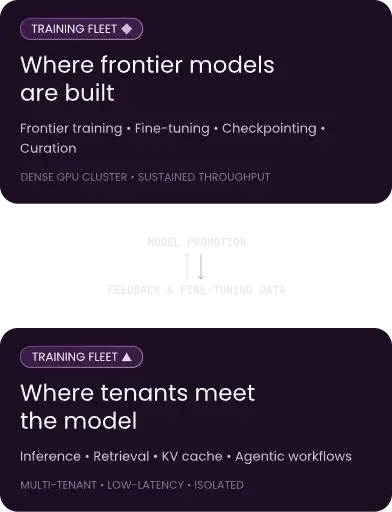
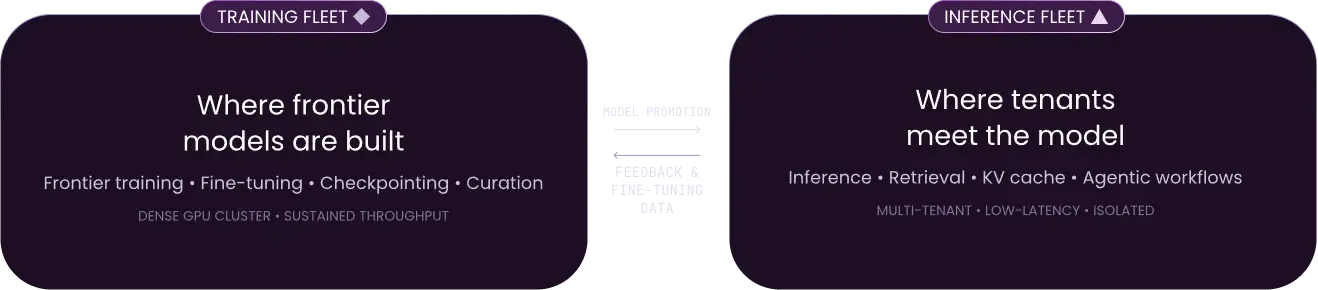
 SCALITY ADI
the scality advantage
Scality technologies that show up most under AI cloud workloads.
AIconnect
The data plane connects to the AI stack.
AIconnect brings Scality ADI into the toolchains NeoCloud tenants already run: training frameworks, vector databases, retrieval pipelines, MLOps. Standard interfaces, NVIDIA-validated GPU-Direct paths, no toolchain rewrite.

Guardian
Operations that scale without scaling the team.
Guardian surfaces insights, recommends actions, and executes within operator-defined policy bounds. NeoCloud teams stay lean as the tenant base grows, with the audit trail attached.

MultiScale
Capacity, throughput, and operations on independent axes.
MultiScale grows each dimension on its own axis. The cluster adds throughput without forcing a capacity refresh, and capacity grows without forcing a performance rebuild. Hardware-flexible, generation-spanning.

VALIDATED AI CLOUD ECOSYSTEM
Integrated with the AI stack NeoCloud tenants already run.
Scality ADI sits underneath the frameworks, GPU-direct paths, vector databases, and orchestration tools running frontier- model and large-scale inference workloads. Tenants don't rebuild the toolchain to put their data on the operator's platform.
 FEATURED PARTNERSHIP
Groupama G2S manages backup and storage for one of France's largest mutual insurance groups. Scality ADI with Guardian autonomous operations carries the day-to-day, freeing the team to focus on the security and control standards that regulated insurance work requires.



Bring the cluster spec. We'll show you the storage.