












 Scality ecosystem & Cloud
Microsoft Azure and Scality
Powering hybrid cloud. Scality complements Azure cloud services with on-prem scale-out storage at the edge, hybrid data workflows across cloud boundaries, and direct interoperability between Amazon S3 applications and Azure Blob Storage.

 The partnership
Scality complements Azure cloud services.
Benefits in a nutshell
What the partnership delivers


On-prem extension of Azure.
Scale-out storage that Azure Stack Hub and Stack Edge customers add for petabyte deployments at the edge.


Hybrid cloud workflows.
Archive, disaster recovery and service bursting between on-prem Scality and Azure.


Azure Blob native format.
Data tiered to Azure stays accessible to Azure Machine Learning, Power BI, Video Indexer and other Azure services.


S3 to Azure Blob translation.
Amazon S3 applications consume Azure Blob without code changes.
The partnership
Four capabilities that bridge on-prem and Azure.
Scality is not an Azure replacement. It is the data layer that lets enterprises run hybrid workloads across cloud boundaries — on-prem where they need scale and control, in Azure where they need cloud services.

 Capability & On-prem extension
Scale-out storage to extend Azure edge solutions.
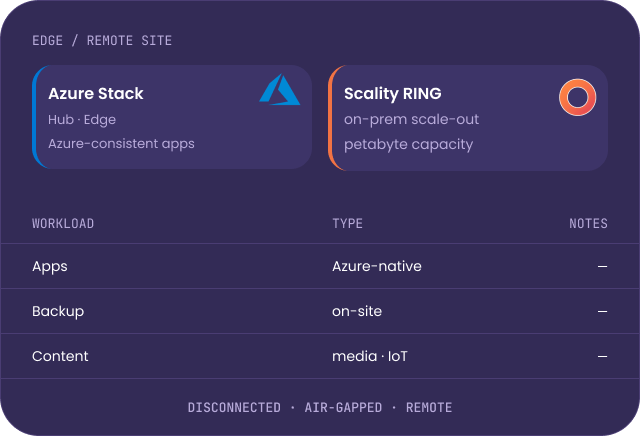
- Petabyte-scale storage at the edge alongside Azure Stack Hub and Stack Edge.
- Azure-consistent applications keep running locally when the cloud link is unavailable.
- Built for disconnected and air-gapped deployments.
- Data orchestration between edge sites and Azure as the link allows.
Capability
On-Prem Extension
Capability
Hybrid Workflows
Capability
Azure Blob Interop

customer story
Hybrid cloud storage at telecom scale.
Orange reduced the cost of cloud storage by running Scality alongside hyperscaler services. The architecture moves data between tiers and clouds without forcing applications to know which back end holds the data.
Why Azure + Scality
What customers get from the combination.

Azure-native data.
Data stored through Scality lands in native Azure Blob format. Every Azure service downstream consumes it without translation.

S3 applications, unchanged.
Existing Amazon S3 applications consume Azure Blob with no code changes. Hybrid and multicloud workflows stay portable.

One data layer, two ends.
On-prem RING and Azure Blob in a single workflow. Archive, DR and bursting work without managing two storage estates.

Data stays in your control.
Scality runs as a stateless layer in your Azure subscription. Data never leaves customer control on the way to Blob.


Talk to Scality, see a demo, or find a reseller.